The classic image of American college life—a group of students huddled around a library table with lukewarm coffee and a mountain of highlighted textbooks—is rapidly becoming a relic of the past. As we move through 2026, the “study group” hasn’t disappeared, but it has fundamentally migrated.
The shift from physical, localized study circles to sophisticated online academic platforms is no longer a trend; it is the new standard. Driven by advancements in AI-powered personalization, a demand for 24/7 flexibility, and the rise of high-stakes academic competition in the US, digital ecosystems are outperforming traditional peer-to-peer groups in every measurable metric.
The Death of the “Meeting Time” Conflict
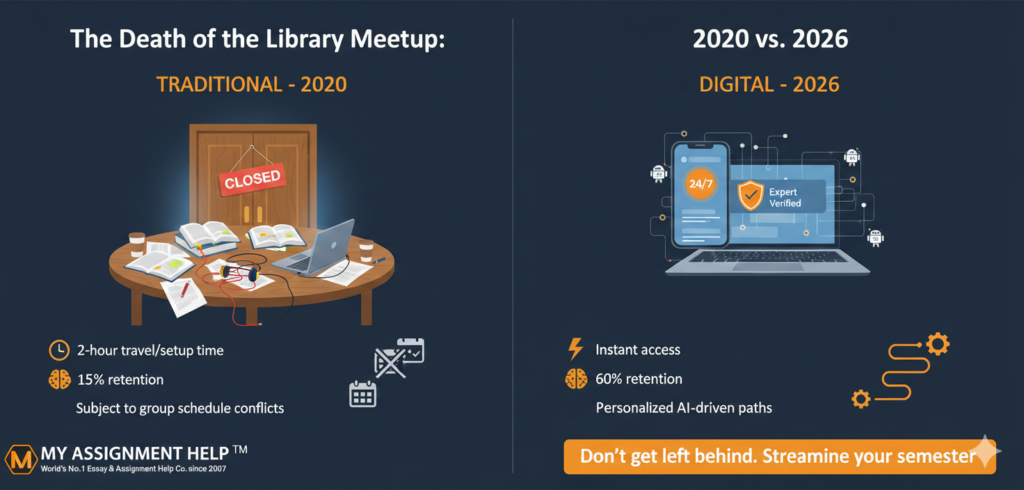
The primary downfall of the traditional study group has always been logistics. In a 2026 academic landscape where 63% of US students balance full-time degrees with “side hustles” or part-time work, finding a two-hour block that fits five different schedules is nearly impossible.
Online platforms solve this by offering asynchronous and on-demand support. Instead of waiting for a Tuesday night meetup to clarify a complex Calculus theorem, students now turn to professional digital hubs. When the pressure of a deadline becomes too much to handle through peer discussion alone, many students choose to do my homework via specialized platforms that offer instant, expert-led solutions. This transition from “group-think” to “expert-access” has reduced the average study time for complex subjects by an estimated 40% to 60%.
Data-Driven Insights: Why the Shift is Permanent
Recent data from the 2025-2026 academic reports highlights a staggering transformation in student behavior across North America:
- Retention Rates: Research indicates that learners retain 25%–60% of material through interactive online platforms compared to just 8%–10% in traditional face-to-face settings.
- Market Growth: The US online learning industry is projected to reach a valuation of $370 billion by the end of 2026.
- The AI Factor: Over 56% of US college students now use AI-integrated platforms to assist with their assignments, citing “accuracy” and “speed” as the primary benefits over peer groups.
The Expertise Gap: Peer Support vs. Professional Mastery
While traditional study groups offer social interaction, they often suffer from “the blind leading the blind.” If no one in the group truly grasps the core concept, the session becomes an exercise in shared confusion.
Modern platforms bridge this gap by providing direct access to subject matter experts. In the competitive US university system, where a single GPA point can determine internship eligibility at Fortune 500 companies, students are less willing to gamble their grades on a peer’s notes. This has led to a surge in students who prefer to pay someone to do my homework to ensure their submissions meet rigorous academic standards. By outsourcing the more tedious or misunderstood components of their curriculum, students can focus on high-level conceptual mastery and career networking.
3 Key Reasons Online Platforms Win in 2026
- Personalized Learning Paths: Unlike a study group that moves at the pace of the slowest member, AI-driven platforms adapt to the individual’s strengths and weaknesses.
- Verified Accuracy: Online hubs use verified educators and advanced plagiarism-detection tools (like the latest 2026 Turnitin updates), ensuring that the help received is both correct and academically sound.
- Resource Integration: Digital platforms house libraries, 24/7 chat support, and interactive simulations in one place, something a library table simply cannot provide.
Key Takeaways for the 2026 Student
- Efficiency is King: Digital tools provide instant answers, eliminating the “logistical lag” of physical meetings.
- Expert Over Peer: Professional guidance offers a higher “Return on Investment” (ROI) for GPA maintenance.
- Hybrid Success: The most successful students use online platforms for core task execution and save physical interactions for high-level networking.
FAQ Section
Q: Are traditional study groups completely obsolete?
A: Not entirely. They still offer social-emotional benefits and networking opportunities, but for technical task completion and grade improvement, online platforms are statistically more effective.
Q: Is using an online platform for homework considered cheating in 2026?
A: It depends on the institution’s policy. Most US universities now encourage the use of EdTech tools for “supplemental learning.” Using platforms to understand complex problems or manage heavy workloads is a common practice in modern academia.
Q: How do online platforms ensure the quality of help?
A: Leading platforms in 2026 employ multi-tier verification processes for their experts and use AI to cross-reference solutions against updated academic databases.
About the Author
Dr. Aris Thorne is a Senior Academic Strategist at MyAssignmentHelp. With over 12 years of experience in the US higher education sector, Dr. Thorne specializes in digital pedagogy and the integration of AI in student productivity. He has authored numerous papers on the evolution of “Study-as-a-Service” (SaaS) and continues to advocate for tech-driven equity in American classrooms.
References:
- Astria Learning (2026). “Top Digital Learning Trends for Universities.”
- Research.com (2026). “10 Online Education Trends: Predictions & Data.”
- Statista (2025). “Growth of Online Tutoring Services in North America.”
- BestColleges (2025). “AI and Assignment Trends in Higher Ed.”